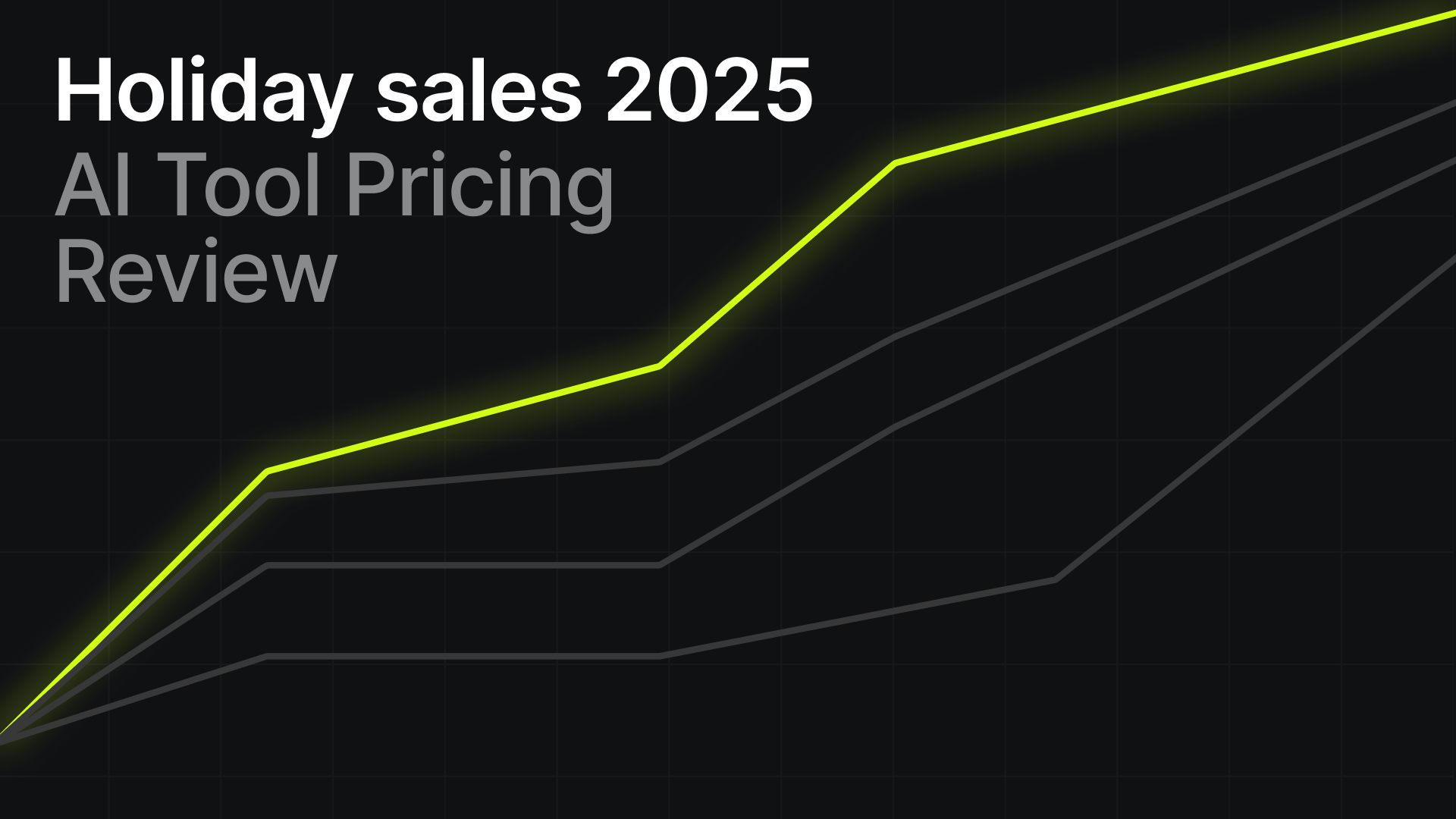

Each year, Holiday Sales provide something of a pressure test for the rapidly evolving world of generative media platforms, bringing forward pricing strategies, subscription adjustments, and model-usage rates that often speak more about the direction of the industry than any single product launch.
Now that the rush has passed, it becomes possible to look at these numbers with a calmer perspective and to understand how the landscape is shifting beneath the surface.
This year’s comparison highlights a set of platforms that have grown familiar to most practitioners in the field, yet it also illustrates the widening gap between how companies value their model outputs and how creators are beginning to think about economic efficiency in workflows.
The data in the image below, taken from a broader internal study of Holiday Sales pricing behavior, compares five major platforms across subscription tiers and per-generation costs for models such as Kling 2.6, Kling 01, Google Veo 3 Fast, and the newly introduced Nano Banana Pro.

This combination of cost has become increasingly important, especially as adoption of generative tools continues to climb across every tier of creator, from independent artists to enterprise-level content teams, following the same trends highlighted in global reports like the recent BCG analysis of GenAI usage growth during peak shopping seasons.
The perspective is consistent with findings in the McKinsey State of AI report, which notes that enterprise adoption increasingly depends on predictable and scalable generative model economics.
A Market Shaped by Increasing Generative Volume
Throughout 2025, workflows involving large-scale video generation, multimodal content creation, text-to-video experimentation, and rapid iteration of short-form visual outputs have expanded dramatically, partly because creators no longer treat these systems as experimental add-ons but incorporate them directly into daily production pipelines.
Gartner’s 2025 outlook echoes this pattern, forecasting substantial acceleration in multimodal and video-first AI systems across both consumer and enterprise markets.
As this shift accelerates, the cost per generation becomes a more defining factor than the flat subscription fee, because the real expense accumulates through repetitive testing, scenario variations, stylistic adjustments, and the continuous refinement that modern GenAI supported video artistry now demands.
The Holiday Sales rates in the chart indicate that platforms are approaching this challenge in very different ways. Some maintain low subscription prices while keeping generation costs relatively high, reflecting a traditional SaaS mindset, while others introduce aggressive discounts on the fixed tier but emphasize usage-based pricing.
A smaller subset, including Higgsfield, experiments with reducing both sides simultaneously, which suggests a strategic bet on user retention and ecosystem growth rather than short-term revenue per generation.
This variation does not imply superiority of one model over another, but it does offer insight into how companies perceive the future of their user base and how they expect creators to scale their output in the next year.
Looking Closely at the Pricing Tiers
The ranking here is not a claim of absolute capability but a result of combining subscription price, discount depth, and model usage cost into a single efficiency index that more closely matches real creative workloads.
During the event, Higgsfield offered a $35 monthly plan with a steep 70% reduction, accompanied by per-generation rates of $0.29 for both Kling models, $0.32 for Google Veo 3 Fast, and an exceptionally low $0.058 for the Nano Banana Pro model, a value that stood out sharply across the comparison due to its unusually low cost relative to its category.
Freepik follows with a $39 monthly tier and moderately higher model-usage rates, making it a familiar option within the broader design and creative ecosystem. Its Nano Banana Pro rate sits at $0.22, creating a balanced mid-range option for users whose workflows depend on experimenting across several model types.
Artlist, ranked third, features a $20 monthly plan but shows noticeably higher per-generation prices for all three models in the comparison, which results in a different cost balance when calculated across high-volume usage. Its Nano Banana Pro pricing, listed at $0.48, follows the same pattern of being positioned at the higher end of the category.
OpenArt presents a $29 tier with mid-range generation costs that vary between Kling 2.6, Kling 01, and Google Veo 3 Fast, creating a pricing profile that sits between the top and lower ends of the list. OpenArt’s Nano Banana Pro rate of $0.29 places it between value-oriented and mid-tier options, consistent with its overall pricing strategy.
Invideo completes the ranking with the highest per-generation pricing across the compared models alongside a $35 subscription plan, a combination that may make it less optimal for creators who rely on frequent, rapid iterations. Invideo, meanwhile, lists Nano Banana Pro at $1.05, which continues its trend of being the costliest platform across most of the compared models.
These distinctions reflect a divergence in long-term strategy, where some companies optimize for breadth of tools, others for specialized creative environments, and a few for uniform affordability that encourages ongoing experimentation.
Why the Industry Is Beginning to Prioritize Efficiency Over Feature Count
A notable trend that emerged this Holiday, echoed by research such as the recent BCG analysis, is a shift toward value measured across the lifecycle of creation rather than at the moment of checkout. Historically, a large discount dominated attention, yet current creators examine how pricing behaves over time, how many generations a platform supports before costs spike, and how predictable their monthly tooling expenses become as their output scales.
This shift matters especially for workflows involving text-to-video, simulation-based motion generation, scene iteration, and rapid prototyping of creative sequences, because these processes rarely conclude with a single generation. They depend on refinement cycles that mirror human storytelling instincts and the increasing demand for precision in visual composition.
When per-generation prices vary dramatically, creators often become conservative in their usage, limiting the depth of exploration and reducing the creative breadth of what could be achieved with broader iteration freedom.
Platforms like Higgsfield, which kept model costs tightly aligned during Holiday Sales, happened to match the emerging user expectation that pricing should not influence artistic decisions. That said, long-term performance still depends on model stability, rendering speed, and tool ecosystem growth rather than pricing alone.
Conclusion
The cost of using GenAI models is no longer hidden beneath promotional labels, and users are increasingly evaluating platforms the same way businesses evaluate cloud infrastructure, meaning they look at consistent performance, predictable cost, and the ability to scale output without fear of runaway expenses. Analyses published by MIT Technology Review reinforce this shift, emphasizing transparency and predictable cost structures as core factors in the sustainable growth of generative model ecosystems.
From this perspective, Higgsfield emerges from the comparison not as an outlier but as a representative of a broader industry movement where competitive pricing and efficient model access shape the next phase of adoption. In this Holiday Sales snapshot, the platform offered the strongest balance between upfront cost and ongoing usage, particularly due to the addition of Nano Banana Pro’s unusually low generation rate.
References
Boston Consulting Group (2025). Black Friday Outlook: Consumers to Shop Earlier as GenAI Usage Spikes. https://www.bcg.com/press/3november2025-black-friday-outlook-consumers-shop-genai-usage-spikes
McKinsey & Company (2025). The State of AI: Adoption, Scaling, and Economic Impact. https://www.mckinsey.com/capabilities/quantumblack/our-insights/the-state-of-ai
Gartner (2025). What’s New in Artificial Intelligence: Multimodal and Video-First Models. https://www.gartner.com/en/articles/what-s-new-in-artificial-intelligence
MIT Technology Review (2024). Artificial Intelligence - Economic Models, Transparency, and Emerging Standards. https://www.technologyreview.com/topic/artificial-intelligence/
Experiment with Today’s Video-Generation Tools Now
Explore advanced video-model capabilities and evaluate how they fit into your production workflow at scale.